Vegetarian Catering: Creating a Menu That Feels Complete
Vegetarian food has always had an important place in Indian celebrations.
From family gatherings and religious functions to weddings, festivals and corporate events, vegetarian menus can offer incredible variety, flavour and creativity.
Yet when planning catering, vegetarian food is sometimes treated as a limited option rather than a complete dining experience.
A truly thoughtful vegetarian catering menu should never feel like a compromise.
It should have enough variety to keep guests interested, enough balance to make the meal satisfying, and enough familiar flavours to make everyone feel comfortable.
Whether your entire event is vegetarian or you simply want a strong vegetarian selection for your guests, careful planning can turn the menu into one of the highlights of the celebration.
In this guide, we will look at how to create a vegetarian catering menu that feels complete, balanced and memorable.
What Makes a Vegetarian Catering Menu Feel Complete?
A complete vegetarian menu is not defined by the number of dishes on the buffet.
It is defined by how well those dishes work together.
A good menu should offer variety across:
- Starters
- Snacks
- Main courses
- Breads
- Rice
- Dal and other lentil preparations
- Vegetables
- Accompaniments
- Salads
- Chutneys
- Desserts
- Indian sweets
- Beverages
The goal is to create a meal where guests have choices without feeling overwhelmed.
A well-planned vegetarian menu can be colourful, filling, traditional, contemporary and suitable for different generations at the same time.
1. Start With the Occasion
The first step is understanding what kind of event you are catering.
A vegetarian wedding menu may look very different from a corporate lunch or a family prayer gathering.
Ask:
- What is the occasion?
- What time of day is the event?
- How many guests are expected?
- What is the overall style of the celebration?
- Are there cultural or religious considerations?
- Is the meal formal or casual?
- Will there be children and senior guests?
For a wedding, you may want a more elaborate selection.
For a smaller family gathering, a focused menu with carefully chosen dishes may be more appropriate.
The menu should serve the occasion rather than simply trying to impress with quantity.
2. Build the Menu in Sections
One of the easiest ways to create a balanced vegetarian catering menu is to plan it section by section.
Instead of starting with a long list of individual dishes, think about the role each part of the meal plays.
A simple structure could include:
Welcome or Snacks
Light bites that guests can enjoy when they arrive.
Starters
A selection of hot or cold vegetarian preparations.
Main Course
A combination of vegetable dishes, paneer or other substantial preparations, dal and complementary gravies.
Breads
Options that work with the selected main courses.
Rice
One or more rice preparations depending on the size and style of the event.
Accompaniments
Salads, chutneys, pickles, raita and other supporting dishes.
Desserts and Mithai
A satisfying finish to the meal.
This approach makes it easier to identify gaps and avoid unnecessary repetition.
3. Create Variety With Indian Vegetables
Vegetarian food gives you an opportunity to showcase the incredible variety of Indian vegetables and cooking styles.
Instead of repeating similar gravies, think about differences in:
- Texture
- Cooking method
- Spice level
- Ingredients
- Regional influence
- Colour
- Richness
For example, you might combine a dry vegetable preparation with a gravy-based dish.
You could pair something mildly flavoured with something more aromatic.
You could also include seasonal vegetables where appropriate.
This creates contrast across the meal.
The important thing is not simply offering many vegetables.
It is giving each dish a reason to be on the menu.
4. Don’t Make Every Dish Heavy
One common mistake when planning vegetarian catering is choosing too many rich dishes.
Paneer, creamy gravies, fried starters and rich desserts can all be delicious.
But when several heavy dishes appear together, the overall meal can become tiring.
Balance is important.
Consider combining richer preparations with:
- Fresh salads
- Raita
- Light vegetable dishes
- Seasonal ingredients
- Simple dal
- Fresh chutneys
- Rice preparations with different flavour profiles
A balanced menu allows guests to enjoy more of the meal comfortably.
5. Give Paneer a Supporting Role
Paneer is one of the most familiar ingredients in Indian vegetarian catering.
It is popular for good reason.
However, a vegetarian menu does not need to depend entirely on paneer.
If several dishes are paneer-based, the menu can start to feel repetitive.
Instead, consider paneer as one component within a larger menu.
Pair it with:
- Vegetable preparations
- Dal
- Rice
- Breads
- Regional dishes
- Seasonal options
This gives guests more variety and makes the overall menu feel thoughtfully designed.
6. Explore Regional Indian Vegetarian Food
India has an extraordinary range of vegetarian cuisines.
This is one of the greatest strengths of vegetarian catering.
You can explore flavours from different regions rather than creating a menu that relies entirely on familiar restaurant-style dishes.
Depending on the occasion, regional influences might come through:
- Rajasthani cuisine
- Gujarati cuisine
- Punjabi cuisine
- South Indian cuisine
- Maharashtrian cuisine
- Bengali cuisine
- North Indian home-style cooking
- Other regional traditions
Regional dishes can bring character to a menu.
They can also give guests the opportunity to experience flavours they may not normally encounter.
The key is to choose dishes that work together rather than creating a menu that feels like a random collection of regional items.
7. Plan Your Starters Carefully
Starters are often the first substantial taste guests have of the catering.
That makes them important.
A vegetarian starter selection can include different textures and preparation styles.
Think about:
- One or two fried options
- Grilled or roasted preparations
- Chaat-style options
- Bite-sized snacks
- Regional favourites
- Fresh or lighter choices
You do not need a huge starter menu.
Instead, create a selection that offers contrast.
For example, if one starter is crispy and rich, another could be grilled or lighter.
This gives guests more choice without making the menu unnecessarily large.
8. Don’t Forget Chaat
For many Indian celebrations, chaat can add a completely different dimension to vegetarian catering.
It brings together texture, freshness, tanginess and spice in a way that feels interactive and familiar.
Depending on the event, a chaat counter can become a popular part of the food experience.
If you are planning one, consider:
- Counter location
- Guest flow
- Preparation
- Serving speed
- Number of staff
- Available toppings and accompaniments
- Hygiene and cleanliness
A live chaat experience can be enjoyable, but it should be planned properly so that queues do not become unnecessarily long.
9. Give Breads and Rice the Right Attention
Breads and rice may seem like supporting parts of the meal, but they have an important role.
The bread selection should work with the gravies and vegetable dishes being served.
Similarly, rice can add another flavour profile to the meal.
Depending on the event, you might consider different styles of:
- Roti
- Naan
- Paratha
- Poori
- Pulao
- Biryani
- Jeera rice
- Regional rice preparations
The exact selection should depend on the rest of the menu.
There is no need to include every possible bread and rice dish.
Choose options that complement the main courses.
10. Make Vegetarian Food Appealing to Everyone
A strong vegetarian menu should not be presented as something only vegetarian guests can enjoy.
Good food is good food.
Many guests who normally eat different kinds of cuisine can still appreciate a thoughtfully prepared vegetarian meal.
This is especially important at weddings and family functions where guests may have different food preferences.
Instead of thinking:
“What can we provide for vegetarian guests?”
think:
“How can we create a vegetarian meal that everyone would enjoy?”
That shift in thinking can completely change the menu.
11. Consider Jain and Other Dietary Requirements
Some vegetarian events may include guests with additional dietary requirements.
For example, certain guests may follow Jain dietary practices or have specific ingredient restrictions.
If this is relevant to your celebration, discuss it with the catering team early.
Do not assume that a dish is suitable simply because it is vegetarian.
Ask about:
- Ingredients
- Preparation methods
- Separate arrangements where required
- Cross-contact considerations
- Labeling
- Serving
Clear communication helps ensure that guests receive food that meets their requirements.
12. Plan for Children and Senior Guests
A wedding or family celebration can bring together several generations.
That means the menu should offer some familiar and approachable choices.
Children may prefer simpler flavours.
Senior guests may appreciate traditional dishes that are familiar to them.
At the same time, younger guests may enjoy trying something different.
A balanced menu can accommodate these differences without becoming complicated.
This is one reason variety matters more than simply adding more dishes.
13. Include Traditional Indian Sweets
Vegetarian catering does not end with the main course.
Desserts are an important part of the experience.
Indian sweets can bring a sense of celebration and tradition to the menu.
Depending on the occasion, you might consider:
- Barfi
- Peda
- Gulab jamun
- Rasgulla
- Jalebi
- Motichoor or boondi-based sweets
- Regional mithai
For weddings and special celebrations, you can also create a dedicated sweet counter.
If you are planning Indian sweets specifically for a wedding, our earlier guide “Indian Sweets for Weddings: Choosing Mithai for Every Celebration” can help you think through the selection.
14. Balance Traditional and Modern Choices
A vegetarian menu does not have to choose between tradition and modern food.
You can have both.
Traditional dishes bring familiarity and cultural connection.
Modern preparations can introduce something new.
The trick is to maintain balance.
If the event is deeply traditional, contemporary choices can be small additions.
If the celebration has a modern style, traditional dishes can provide a sense of warmth and identity.
The menu should ultimately feel like it belongs to the celebration.
15. Think About Seasonal Ingredients
Seasonality can make a difference to both taste and menu planning.
Different vegetables, fruits and ingredients naturally work better at different times of the year.
For a summer celebration, you may want fresher and lighter options.
During cooler months, richer and warmer preparations may feel more appropriate.
Seasonal thinking can also prevent menus from becoming too predictable.
Instead of repeating exactly the same dishes throughout the year, you can allow the menu to evolve with the season.
16. Consider the Service Style
The way vegetarian food is served can affect the guest experience.
Options may include:
- Buffet service
- Plated meals
- Family-style service
- Live counters
- A combination of formats
For large celebrations, buffet service can give guests the freedom to choose what they want.
For smaller gatherings, another service style may work better.
Think about:
- Guest count
- Venue size
- Seating arrangement
- Menu complexity
- Event timing
- Guest movement
A good menu deserves a service setup that allows guests to enjoy it comfortably.
17. Don’t Forget Food Presentation
People experience food with their eyes before they taste it.
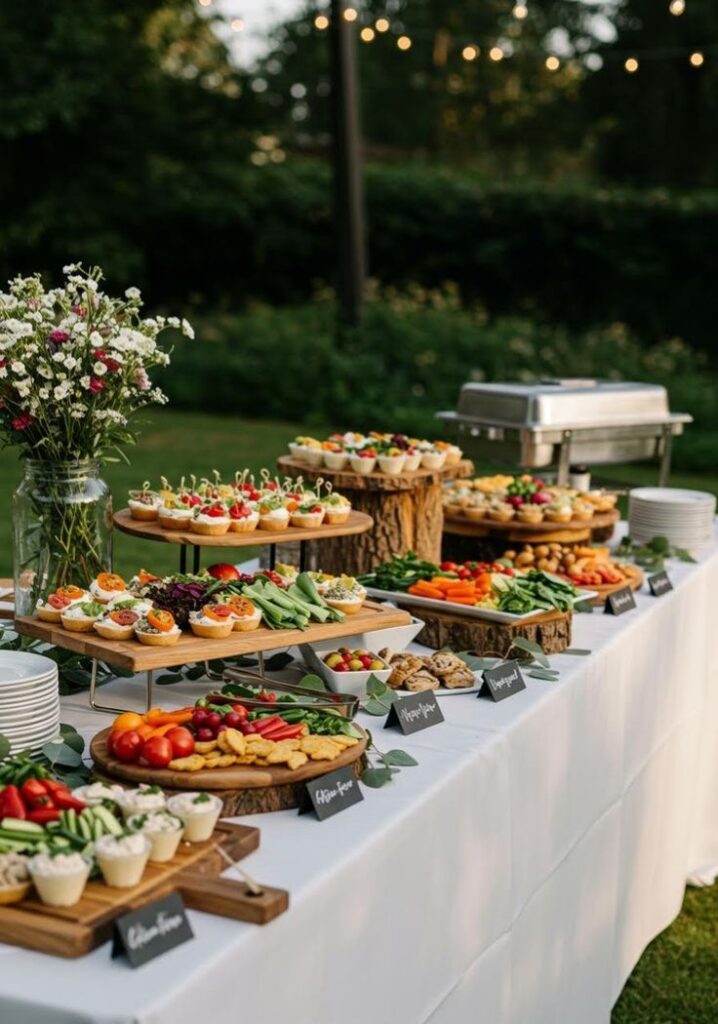
A well-organized vegetarian buffet can look colourful and inviting because of the natural variety of vegetables, breads, rice, salads, chutneys and desserts.
Presentation can include:
- Clean serving vessels
- Clear arrangement
- Appropriate labels
- Thoughtful buffet flow
- Attractive dessert presentation
- Organized live counters
The aim is not to make every dish overly decorative.
Good presentation should make the food easy to understand and enjoyable to explore.
18. Think About Food Freshness and Timing
Even the best vegetarian menu can lose its appeal if food is not served at the right time.
Before the event, discuss:
- Preparation schedule
- Cooking times
- Buffet opening time
- Replenishment
- Live counter timing
- Food storage
- Service flow
This is especially important for large events.
A well-coordinated catering team can help ensure that guests experience the food as it was intended to be served.
19. Plan Quantities Based on the Whole Menu
When planning food quantities, look at the complete menu rather than estimating each dish independently.
If you have many starters, several main courses, breads, rice, sweets and desserts, guests will naturally divide their portions among the available choices.
The expected guest count also matters.
Your caterer can help determine appropriate quantities based on:
- Number of guests
- Number of dishes
- Event duration
- Meal timing
- Service style
- Expected guest preferences
The objective is to provide enough food while avoiding unnecessary excess.
20. Choose Quality Over an Oversized Menu
A common misconception is that a premium vegetarian menu needs a very large number of dishes.
It doesn’t.
A thoughtfully selected menu of well-prepared dishes can create a better experience than an oversized buffet where guests struggle to decide what to eat.
Ask yourself:
Does every dish add something different?
If the answer is no, the menu may need editing.
Good catering is not about filling every available space on the buffet.
It is about creating a meal that feels complete.
A Practical Vegetarian Catering Checklist
Before finalizing your menu, use this checklist.
Event Planning
☐ Confirm the type of event
☐ Confirm guest count
☐ Note event timing
☐ Understand guest preferences
☐ Identify dietary requirements
☐ Decide your catering budget
Menu Planning
☐ Choose welcome snacks
☐ Select vegetarian starters
☐ Consider a chaat or live counter
☐ Choose vegetable preparations
☐ Select paneer or other substantial dishes
☐ Add dal or lentil preparations
☐ Choose breads
☐ Choose rice
☐ Plan salads and accompaniments
☐ Select Indian sweets
☐ Decide on additional desserts
☐ Balance rich and lighter dishes
☐ Consider regional cuisine
☐ Consider seasonal ingredients
Service Planning
☐ Decide buffet or plated service
☐ Confirm live counter requirements
☐ Plan buffet layout
☐ Confirm service staff
☐ Discuss food timing
☐ Discuss replenishment
☐ Confirm hygiene arrangements
☐ Plan for senior and child guests
Final Confirmation
☐ Finalize menu
☐ Confirm quantities
☐ Confirm dietary requirements
☐ Confirm preparation and serving arrangements
☐ Confirm event timings
☐ Review the complete menu for balance
Common Vegetarian Catering Mistakes to Avoid
1. Assuming Vegetarian Means Limited
Vegetarian cuisine offers enormous variety.
Treat it as a complete culinary experience rather than a restricted menu.
2. Using Too Much Paneer
Paneer is popular, but several paneer dishes can make a menu feel repetitive.
3. Making Everything Rich
A meal needs contrast.
Include fresh, lighter and simpler preparations alongside richer dishes.
4. Adding Dishes Just for Quantity
Every dish should have a purpose.
If two dishes are nearly identical, you may not need both.
5. Ignoring Regional Food Traditions
Regional Indian vegetarian cuisine can bring personality and authenticity to a menu.
6. Forgetting Dietary Requirements
Always discuss specific requirements before finalizing the menu.
7. Overlooking Service
A great menu needs an organized service plan.
Food should be accessible, replenished and served comfortably.
Frequently Asked Questions About Vegetarian Catering
What should a vegetarian catering menu include?
A balanced vegetarian catering menu can include starters, vegetables, dal, breads, rice, salads, accompaniments, sweets, desserts and beverages. The exact selection should depend on the event and guests.
How do you make a vegetarian menu feel complete?
Focus on variety rather than quantity. Combine different textures, flavours, cooking styles and regional influences while balancing rich and lighter dishes.
Is paneer necessary in a vegetarian catering menu?
Paneer is popular but not essential. A strong vegetarian menu can include many other ingredients, regional dishes, vegetables, lentils and grains.
How can I plan a vegetarian wedding menu?
Start with the wedding functions, guest count and event style. Then build each menu section by section, considering guest preferences, dietary requirements, service style, season and budget.
Can vegetarian catering work for guests with different food preferences?
Absolutely. A well-designed vegetarian menu can offer enough variety for guests with different tastes and age groups. The key is thoughtful selection rather than simply increasing the number of dishes.
The Annmay by MSC Approach
At Annmay by MSC, we believe vegetarian food deserves to be treated with the same creativity, care and attention as any other cuisine.
Indian vegetarian food has an incredible depth of flavour and tradition.
It can be comforting and familiar, festive and elaborate, regional and contemporary — sometimes all within the same celebration.
Our focus is on creating a food experience that feels complete.
That means thinking about the menu as a whole, understanding the occasion, considering the guests and paying attention to the way food is served.
Because catering is not only about preparing dishes.
It is about creating an experience where people can sit together, share food and enjoy the occasion.
Our philosophy remains simple:
Love Everyone. Serve Everyone. Remember God.
Final Thoughts
A great vegetarian catering menu does not need to prove that vegetarian food can compete with anything else.
It simply needs to be good.
It should offer variety without unnecessary excess.
It should respect tradition while leaving room for creativity.
It should give children something familiar, older guests something comforting and adventurous guests something new to discover.
Most importantly, it should make every guest feel considered.
Whether you are planning a wedding, family celebration, religious function, corporate gathering or another special event, vegetarian catering can be one of the most satisfying and memorable parts of the meal when it is planned thoughtfully.
Because a complete meal is not defined by what is missing.
It is defined by what is brought to the table.
Planning a Vegetarian Celebration?
If you are planning a wedding or family celebration and looking for a catering team that values food, service and hospitality, Annmay by MSC would be happy to be part of your celebration.
Love Everyone. Serve Everyone. Remember God.